Saturday, February 10, 2007


Reading in the Rain
Left Coast Crime Convention
February 1-4, Seattle, WA

I'm taking a little break in my intense "catching up" after a wonderful trip to Seattle. Left Coast is a nice convention. Not on the same scale as Bouchercon, but big enough for a lot of fun, and for me to drop more than a few quarters on books. Ahem.

Here is a group of DAPA-EM members (past and present) with whom I had dinner on night #1. Left to right we've got Thom Walls, Ted Fitzgerald, Bryan Barrett, and Cap'n Bob Napier. As I looked around the table, I noted that all five of us had beards. After taking our drink orders, our waiter asked if we were, by any chance, here for the mystery convention. We were surprised. The restaurant was way downtown from the convention hotel. Were we that transparent? It turned out that the waiter, Bruce Fergusson, was himself a novelist. (And we thought they were all struggling actors). Back in 1999 he had written The Piper's Sons to positive reviews.

Cap'n Bob did a short presentation about the Plot Genii, a book and spinner device used to concoct mystery plotlines. The usefullness of the device is dubious, but the presentation was entertaining. Afterwards several DAPA-EM members (and Chris Aldrich) posed with Bob. Pictured are Roger Sobin, Cap'n Bob (kneeling), Kate Derie, Ted Fitzgerald, Chris Aldrich, and myself. Maggie Mason escaped before the picture was taken. [NOTE: it was pointed out to me that I look especially fat in this picture. I could stand to loose a few pounds, but this is honestly bad posture and/or bad lighting.]
Here, a very busy DAPA-mEMber, Janet Rudolph, shares her infectious smile with authors Steve Brewer and Colin Campbell.

Friday evening the NW chapter of Mystery Writers of America co-hosted a reception at Doc Maynard's, a gold-rush era saloon in Pioneer Square. The reception included a tour of Underground Seattle with a particularly adult bent. We learned quite a bit about prostitution in the late 19th century. Pictured here are Meg Chittenden and Con Lehane, enjoying drinks at the Doc Maynard bar. (Con, being the author of a series featuring bartender-sleuth Brian McNulty, knows his way around a bar).
At the "Lefty" banquet, I enjoyed dinner with fellow DAPA-mEMbers Ted Fitzgerald and Roger Sobin, along with Roger's wife Genie. Also at our table were Rick Blechta, Diana Chambers, and Charles Benoit (pictured left to right in photo below), all who participated in brilliant panel on mysteries in remote locales. Charles regaled us with amusing stories of his days in the Army as part of the Presidential Guard. (Charles' website is a stitch - give it a visit).


Genie and Roger Sobin and me. Roger was having bizarre luck at the dinner. One waiter clocked him right on the bridge of his nose with a salad plate. Then an hour later a different waiter poured coffee down his back. He didn't do anything to deserve it! Just wrong place, wrong time.


Finally, here are a few of us enjoying cocktails at the bar. That's Ted again on the left, a woman whose name I think is Betsy, [CORRECTION: Her name is Emily. Thanks Ted and Maggie] then Meg Chittenden, and myself.

Monday, January 15, 2007

REVIEW: Love, Death and the Toyman
by Robert S. Napier
Five Star Books, 2007. $25.95


When someone I know writes a book, it makes me happy. I go out, buy the book, and promise myself that I'll read it sometimes soon. When someone I know - someone who's never published book-length fiction before - writes a really good book, I'm overjoyed. Such was the case when I learned about Cap'n Bob Napier's new book, when I bought it, when I admired the sexy cover, and when I cracked it open and began reading.


Don't get me wrong, Love, Death and the Toyman is not Charles Dickens. Nor is it in the same league as say a Michael Connelly novel. But from start to finish, it was a joy to read.

The Toyman of the title is Jack Lorentz, former investigative reporter with some combat training in his background. Jack is now a collectible toy dealer working out of an antique co-op in Tacoma, Washington.

When Mrs. Amanda Howard shows up at his office, he's not sure what to expect at first. Is this some lady wanting to unload an attic full of old dolls, lunchboxes, or toy soldiers? But one look at the woman's face brings back a decade and a half of angst. Mrs. Howard is no other than Mandy, the girlfriend who got away fifteen years earlier; not just got away, but disappeared from his life without explanation and married a billionaire.

Human remains have been found on one of the Howard family properties, and the family wishes to hire Jack to learn who the bones belong to, and to make sure they don't create a scandal that would hurt Michael Howard's (Mandy's husband) political ambitions.

Plot, and to a certain extent style, owe much to the Lew Archer novels of Ross Macdonald, and to a lesser and looser extent (although I can't say why without spoiling the plot) to Mark Twain. The stymied romance is handled well, as is the treatment of the Howard family (Mandy's ambitious and resentful brother--in-law, her pedigree-fixated sister-in-law, her ne'er do well nephew, and her insane niece reminiscent of Carmen Sternwood from Chandler's The Big Sleep).

Love, Death and the Toyman was a fun, fast-paced read. Plot, characters, and setting held up very well. (One plot-element that was left hanging - I assume I must have sneezed or reached for my coffee and missed it - was the Poontang Patty subplot). [UPDATE - 2/10/07 - Okay, I was definitely asleep at the wheel. Re-reading this section the identity and nature of Poontang Patty is clear. I can't say more without spoiling surprises]. Reading Cap'n Bob's first book was a pleasant reminder of why I became a mystery fan in the first place. And speaking of fans. . .

Robert ("Cap'n Bob") Napier is a long-time and well-known mystery fan. For 19 years (and 200 issues) he published Mystery & Detective Monthly (MDM), a newsletter composed largely of correspondences from mystery fans, collectors, and authors. In 1997 Bob was named Fan Guest of Honor at the Monterey Bouchercon. Over the years, Bob has also been named the world's (or possible "the word's") most lovable curmudgeon. Included in the cast of characaters is Beth Fedyn, Jack Lorentz' close friend and the receptionist/clerk at Olden Daze Collectibles. Beth is named for another famous fan, the Wisconsin-based fan, reviewer, MDM contributor, and DAPA-EM member.


Wednesday, January 03, 2007

Found Things.

As a collector of old books, I sometimes find curiosities that have been left behind by past readers. Two such items came to light while I was cataloging books into LibraryThing.

ITEM #1.
I was comparing my two copies of Jacques Futrelle's final book, My Lady's Garter (published in 1912, shortly after the author perished in the sinking of the Titanic), when I noticed that my A.L. Burt edition had been stamped on multiple pages by a previous owner of the book.

In 1922, Edward A Froehling inscribed his name inside the front cover of the book, and sometime thereabouts embellished the book with this cute little rubber stamp impression:


E. A. FROEHLING
"AND PLEASE RETURN IT. YOU MAY THINK THIS A STRANGE REQUEST BUT I FIND THAT THOUGH MANY OF MY FRIENDS ARE POOR ARITHMETICIANS, THEY ARE NEARLY ALL OF THEM GOOD BOOK-KEEPERS."


ITEM #2

I am a book reviewer for several magazines, and receive a fair number of review copies. These review books usually come with a press sheet folded up inside the book, telling me about the book, about the author, and details such as publication date, price, and contact information. Tucked inside my hardcover copy of Dwight V. Babcock's The Gorgeous Ghoul I found this little item:

Wednesday, December 27, 2006

REVIEW:
The Feather Cloak Murders
by Darwin and Hildegarde Teilhet
1936 Doubleday, Doran and Co.

An ancient Hawaiian ceremonial cloak, an ocean cruise, romance on the Hawaiian islands, and several bizarre murders. It's the ingredients of a good mystery, especially coming from Darwin Teilhet and wife Hildegarde, who wrote three other novels featuring the Baron von Kaz as well as various Polynesian romances, picaresque adventures, and impossible crime novels. With Feather Cloak Murders, the Teilhets don't quite pull it off.

First the good: The Feather Cloak Murders contains nice, exotic settings (aboard the ocean liner Kohala and ashore on various Hawaiian islands) about which the Teilhets are very familiar. The denouement is clever and multi-leveled.

Baron Franz Maximilian KaragĂ´z von Kaz is a unique hero. I have a tough time guessing precisely what he looks like, but I imagine a largish, well-built man with somewhat dark features, probably around 30 years old. He is likeable, but as conceited as they come. He's so quick to remind us how brave he is, that the narrator frequently refers to him as "the brave Baron von Kaz." He is pretentious, particularly with women. He is infatuated with Caryl Miquet (although he would say that he's merely destined to be her valiant protector), and is convinced she has mutual affections toward him despite the annoyance and irritation she shows. (In the end, the romance does turn in the Baron's favor). The Baron is an Austrian noble with some gypsy blood, but has been avoiding his motherland for rather vague financial, legal, and/or political reasons. (Among other things, he is an ardent anti-fascist). In short, the Baron has the stubborness of Nero Wolfe, the stiff foreign idiosyncracies of Hercule Poirot, and the snobbish conceit of Philo Vance.

Caryl Miquet is traveling from California to Hawaii along with her cousins Mary and young Billy McKay and three men. The Baron is aboard as well, serving as bodyguard to Mr. Hiroshita who is bringing (or so he says) a valuable jade to Hawaii. Toward the end of the voyage, the Baron stumbles upon the body of Kohler, a man who has been dogging Hiroshita. Kohler was killed by a dart shot from an airgun. Shortly after landing in Honolulu, Mr. Hiroshita is similarly killed by the same weapon.

Throughout the convoluted plot, after his initial client is killed, the Baron is hired by Japanese gangsters to recover a 57 carat Aztec diamond, and then by Miss Miquet to discover who has been going through her mail. Eventually we learn that the real plot is to find a map, hidden inside a soapstone plaque, which reveals the location of Prince Puakini's tomb (deep within volcanic caves) and recover the priceless feather cloak.

While reading The Feather Cloak Murders was not unpleasant, I was forced to page back and forth numerous times to keep track of what was going on, and in the end I was left wondering about plot elements that seem to have been forgotten by the author.

The Feather Cloak Murders did not engage me as well as Teilhet's previous Baron von Kaz novel, The Ticking Terror Murders. Nor, from all accounts, is it as good a novel as the subsequent Crimson Hair Murders, which I will, to be sure, be reading in the near future.

Sunday, December 24, 2006

Collecting Jacques Futrelle

The notion of a writer, referred to during his life as the American Arthur Conan Doyle, who perished aboard the Titanic at the height of his career. . . well, I was intrigued.

During his short life, Futrelle produced 8 novels and 48 published short stories. He is best known for the 48 short stories and novelettes he wrote featuring Professor Augustus S. F. X. Van Dusen, Ph. D., LL. D., F. R. S., M. D, the brilliant logician known popularly as "The Thinking Machine."

The Thinking Machine's "Watson" was news reporter Hutchinson Hatch. The most famous "Thinking Machine" story is "The Problem of Cell 13," in which Professor Van Dusen challenges the claim that the new cells at Chisholm Prison are completely inescapable. Sadly, five years after van Dusen proves the inescapable cell to be escapable, the "unsinkable" HMS Titanic would sink, leaving May Futrelle a widow.

I found the Scholastic Books collection of Thinking Machine stories easily. The Dover collection, edited by Everett Bleiler, was equally accessible. "The Problem of Cell 13" can be found in countless anthologies. But getting my hands on original Jacques Futrelle books proved to be more of a challenge, even in this age of eBay and Internet commerce.

About a year and a half of eBay searching yielded most of the non-Thinking Machine books.

Diamond Master (1909) (left) is a crime novel involving a conspiracy to upset world commerce by producing man-made diamonds. There's nothing Jewish about the story - no Jewish crooks, diamond-merchants, or conspirators. But the Saturday Evening Post serialized the story with the cover art shown on the right.


Other non-Thinking Machine titles include The High Hand (1911) and My Lady's Garter (published posthumously in 1912). The Chase of the Golden Plate (1906) was Futrelle's first novel, and while I haven't read it yet, I've been led to understand that it contains The Thinking Machine incidentally.

Here is my real prize: a nice, pristine first edition of The Thinking Machine (1907). I particularly like the portrait of Professor van Dusen surrounded by the scribbly signature-like design. Within a year of finding The Thinking Machine, I acquired a copy of the 1917 reprint (retitled The Problem of Cell 13) as well as the small volume The Professor on the Case (the British printing of The Thinking Machine of the Case)


Tuesday, December 12, 2006

Shelf Life - The Second Story

Here are a couple of photos of my three-tiered shelf insert. I have three of these, set into the shelves of a wide kitchen-style shelf unit.

Each step lifts the books 4 inches up from those in front of them. The side-panels I cut from a nice-quality thin plywood (I think its 1/4" or less), which serve as bookends.


The whole purpose of these, again, is to get more bang for my shelf-space - to be able to store three rows of books on a single shelf and still be able to see all the books.

What's the point of owning books if you can't see them?


Saturday, December 09, 2006

Shelf Life


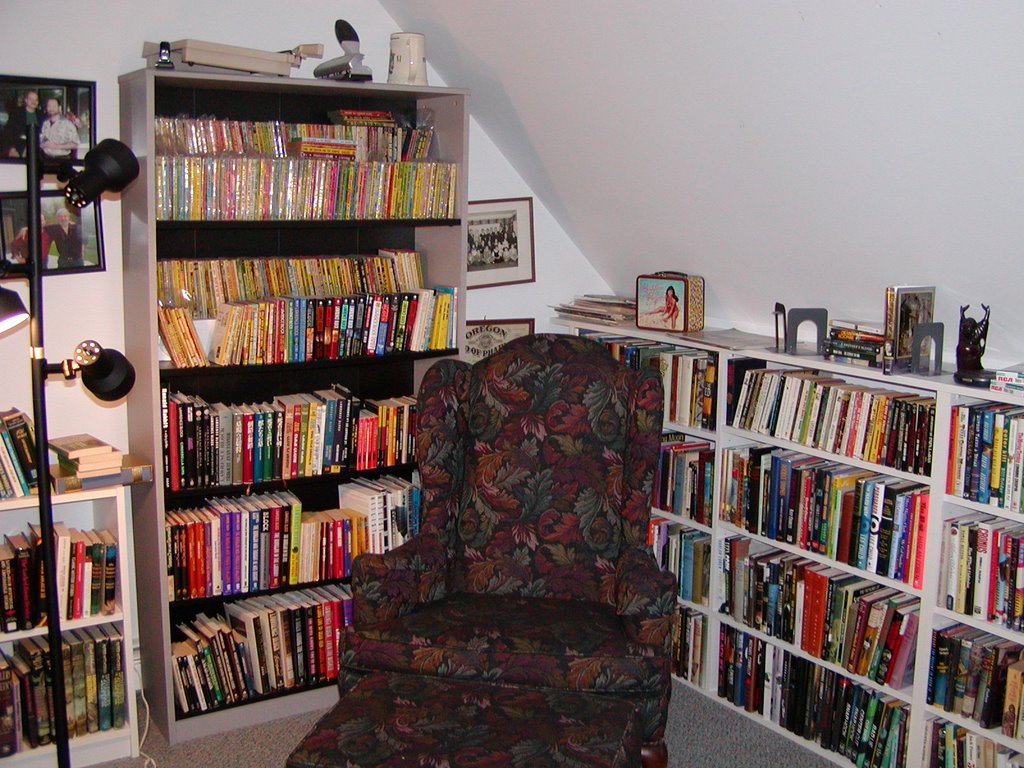
I thought I'd share a few photos of my library (prompted by a request from Parkersmood at LibraryThing, who wanted to see my guilt-free method of double-stacking).


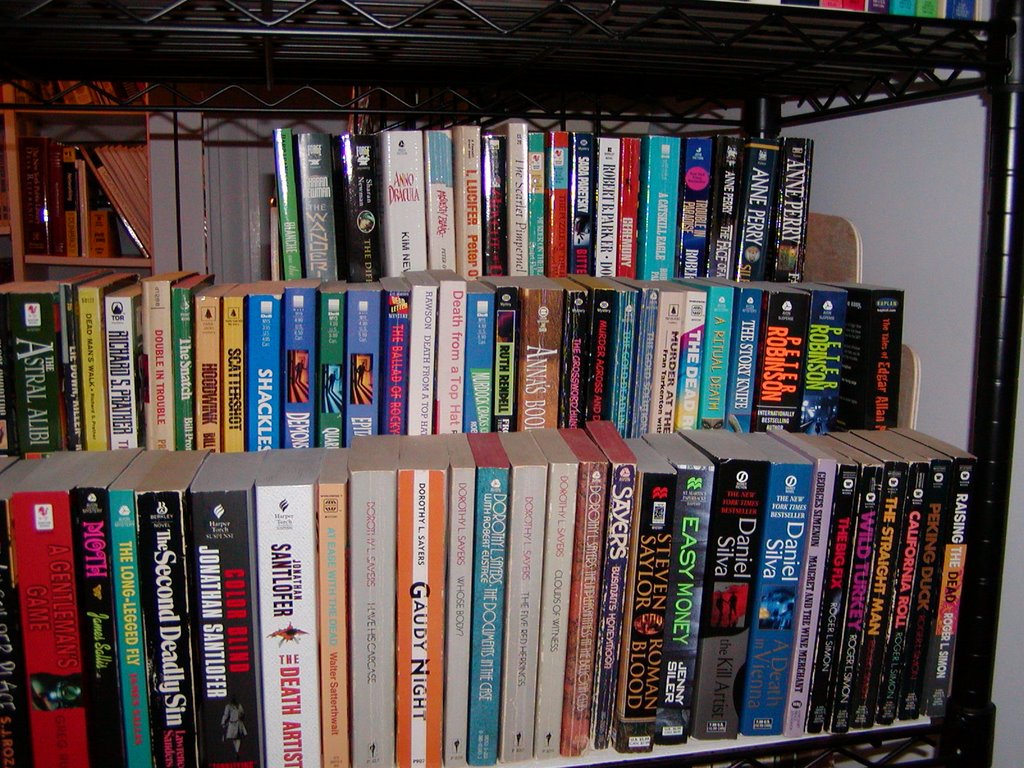
Here is a section of mass-market paperbacks with a few books removed to show the shelf-insert I built that enables me to display two layers of books on a single shelf.

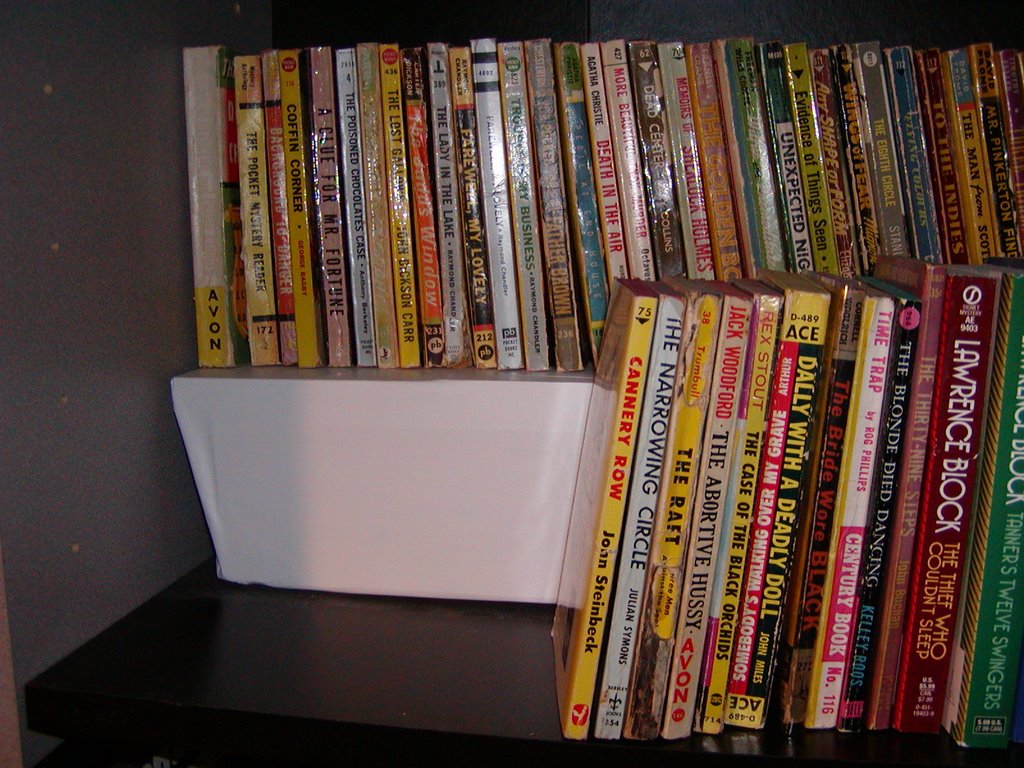
Next photo, from my vintage paperbacks, shows a similar shelf-insert that I covered in contact shelf-paper to protect the books from possible damage from the lumber.


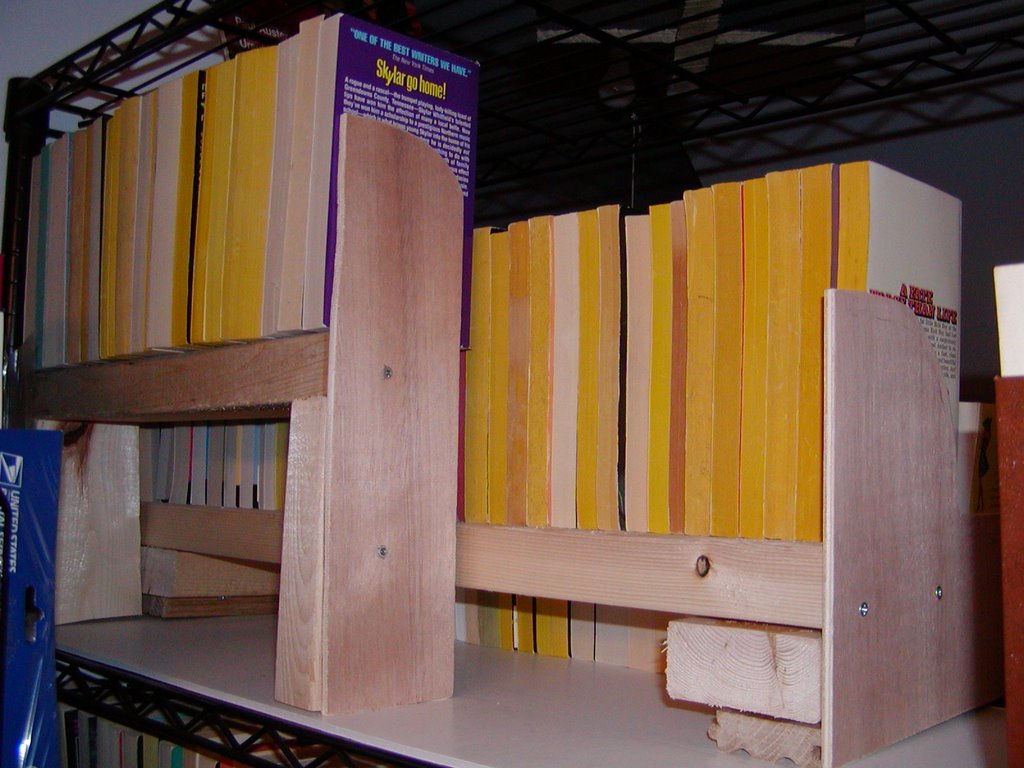
I did a similar thing, a little more elaborate, when I built this three-tiered unit (front view and rear view):


Stay tuned for more. . .