MAGIC AND MARGARET MARON
The marvelous Margaret Maron, for those readers who aren't already acquainted, is the author of more than twenty novels and a ton of short stories, and has accumulated a mantle filled with awards and honors for her work. (One book alone, The Bootlegger's Daughter (1992), swept the mystery prizes of its year, including Edgar, Agatha, Macavity, and Anthony Awards).
I had the chance to spend some time with Margaret a few weeks back at Malice Domestic. And today I learned that she wrote a column about me on her web page.
Sunday, May 23, 2010

Thursday, December 24, 2009
In 1901, G.K. Chesterton published a series of sixteen essays under the title The Defendant. Each essay is written in "Defense of" some thing or another. Below is the fifteenth chapter for your amusement and edification:
A DEFENCE OF DETECTIVE STORIES
by Gilbert Keith Chesterton
In attempting to reach the genuine psychological reason for the popularity of detective stories, it is necessary to rid ourselves of many mere phrases. It is not true, for example, that the populace prefer bad literature to good, and acceptdetective stories because they are bad literature. The mere absence of artistic subtlety does not make a book popular. Bradshaw's Railway Guide contains few gleams of psychological comedy, yet it is not read aloud uproariously on winter evenings. If detective stories are read with more exuberance than railway guides, it is certainly because they are more artistic. Many good books have fortunately been popular; many bad books, still more fortunately, have been unpopular. A good detective story would probably be even more popular than a bad one. The trouble in this matter is that many people do not realize that there is such a thing as a good detective story; it is to them like speaking of a good devil. To write a story about a burglary is, in their eyes, a sort of spiritual manner of committing it. To persons of somewhat weak sensibility this is natural enough; it must be confessed that many detective stories are as full of sensational crime as one of Shakespeare's plays.
There is, however, between a good detective story and a bad detective story as much, or, rather more, difference than there is between a good epic and a bad one. Not only is a detective story a perfectly legitimate form of art, but it has certain definite and real advantages as an agent of the public weal.
The first essential value of the detective story lies in this, that it is the earliest and only form of popular literature in which is expressed some sense of the poetry of modern life. Men lived among mighty mountains and eternal forests for ages before they realized that they were poetical; it may reasonably be inferred that some of our descendants may see the chimney-pots as rich a purple as the mountain-peaks, and find the lamp-posts as old and natural as the trees. Of this realization of a great city itself as something wild and obvious the detective story is certainly the 'Iliad.' No one can have failed to notice that in these stories the hero or the investigator crosses London with something of the loneliness and liberty of a prince in a tale of elfland, that in the course of that incalculable journey the casual omnibus assumes the primal colours of a fairy ship. The lights of the city begin to glow like innumerable goblin eyes, since they are the guardians of some secret, however crude, which the writer knows and the reader does not. Every twist of the road is like a finger pointing to it; every fantastic skyline of chimney-pots seems wildly and derisively signalling the meaning of the mystery.
This realization of the poetry of London is not a small thing. A city is, properly speaking, more poetic even than a countryside, for while Nature is a chaos of unconscious forces, a city is a chaos of conscious ones. The crest of the flower or the pattern of the lichen may or may not be significant symbols. But there is no stone in the street and no brick in the wall that is not actually a deliberate symbol—a message from some man, as much as if it were a telegram or a post-card. The narrowest street possesses, in every crook and twist of its intention, the soul of the man who built it, perhaps long in his grave. Every brick has as human a hieroglyph as if it were a graven brick of Babylon; every slate on the roof is as educational a document as if it were a slate covered with addition and subtraction sums. Anything which tends, even under the fantastic form of the minutiae of Sherlock Holmes, to assert this romance of detail in civilization, to emphasize this unfathomably human character in flints and tiles, is a good thing. It is good that the average man should fall into the habit of looking imaginatively at ten men in the street even if it is only on the chance that the eleventh might be a notorious thief. We may dream, perhaps, that it might be possible to have another and higher romance of London, that men's souls have stranger adventures than their bodies, and that it would be harder and more exciting to hunt their virtues than to hunt their crimes. But since our great authors (with the admirable exception of Stevenson) decline to write of that thrilling mood and moment when the eyes of the great city, like the eyes of a cat, begin to flame in the dark, we must give fair credit to the popular literature which, amid a babble of pedantry and preciosity, declines to regard the present as prosaic or the common as commonplace. Popular art in all ages has been interested in contemporary manners and costume; it dressed the groups around the Crucifixion in the garb of Florentine gentlefolk or Flemish burghers. In the last century it was the custom for distinguished actors to present Macbeth in a powdered wig and ruffles. How far we are ourselves in this age from such conviction of the poetry of our own life and manners may easily be conceived by anyone who chooses to imagine a picture of Alfred the Great toasting the cakes dressed in tourist's knickerbockers, or a performance of 'Hamlet' in which the Prince appeared in a frock-coat, with a crape band round his hat. But this instinct of the age to look back, like Lot's wife, could not go on for ever. A rude, popular literature of the romantic possibilities of the modern city was bound to arise. It has arisen in the popular detective stories, as rough and refreshing as the ballads of Robin Hood.
There is, however, another good work that is done by detective stories. While it is the constant tendency of the Old Adam to rebel against so universal and automatic a thing as civilization, to preach departure and rebellion, the romance of police activity keeps in
some sense before the mind the fact that civilization itself is the most sensational of departures and the most romantic of rebellions. By dealing with the unsleeping sentinels who guard the outposts of society, it tends to remind us that we live in an armed camp, making war with a chaotic world, and that the criminals, the children of chaos, are nothing but the traitors within our gates. When the detective in a police romance stands alone, and somewhat fatuously fearless amid the knives and fists of a thieves' kitchen, it does certainly serve to make us remember that it is the agent of social justice who is the original and poetic figure, while the burglars and footpads are merely placid old cosmic conservatives, happy in the immemorial respectability of apes and wolves. The romance of the police force is thus the whole romance of man. It is based on the fact that morality is the most dark and daring of conspiracies. It reminds us that the whole noiseless and unnoticeable police management by which we are ruled and protected is only a successful knight-errantry.


Thursday, September 24, 2009
I just rediscovered a short piece I wrote some time ago about Jacques Futrelle. My friend Lou Boxer, organizer for Philadelphia's Noircon, posted this on the Noircon blog. I've written about Futrelle here before, so much of what you'll read will be repetition. But it's a fun piece - if I may say so myself.
Monday, March 16, 2009

Doubleday Crime Club, part 1
Beginning in 1928, the American publisher Doubleday, Doran began issuing titles under the imprint The Crime Club. These books were accompanied by a cute logo that looked, depending on how you stared at it, either like a man holding a gun, or a man falling (after having been shot?). A closer examination reveals that the logo is comprised of stylized versions of the letters C-R-I-M-E.
 The Doubleday Crime Club was not a book-of-the-month type of enterprise. They did offer a subscription service, and subscribers saved a little bit of money (what amounted to postage). But the books issued by the Crime Club were not inexpensive copies. In fact, they were among the finest hardcover editions of mystery and detective fiction of the time.
(In later years, the Book of the Month Club did work out an arrangement with Doubleday, so you can find Doubleday Crime Club volumes that are also what collectors call "Book Club editions." Confused yet?)
Above and to the right are several Crime Club volumes, mostly from the mid-1930s, showing some of the clever embossed spine art from that period. Even without dustjackets, these were beautiful books.


 Here is a sampling of books from my shelves, all with nice dustjackets, and dating from 1928 through 1931.
As time permits, I'll be posting more trivia, artwork, and history of the Crime Club.
Meanwhile, be sure to visit my regular weekly blog-gig over at Criminal Brief. You'll find my column there every Friday.
Wednesday, January 14, 2009
R.I.P. Danger Man
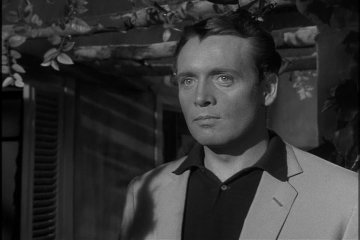
Just last night I was watching an episode of "Secret Agent," the early 1960s spy ITV television program ("Danger Man" in the UK) with my family. Then today I learn of the passing of Patrick McGoohan at age 80.
I first discovered McGoohan when I was a half-pint devotee of Walt Disney's Wonderful World of Color every Sunday night in Black and White. McGoohan appeared in two Disney films that I remember well: "The Three Lives of Thomasina" (based on Paul Gallico's novel), and The Scarecrow of Romney Marsh (based on the swashbuckling character of Russell Thorndike's novels).
As a teenager and college student, I rediscovered McGoohan as "Number Six" in the mind-bending science fiction spy program "The Prisoner."
Apparently AMC is putting together a miniseries remake of The Prisoner starring Jim Caviezel as Number Six and Ian McKellen as Number Two. I look forward to it, but my guess is that most of the mysteriousness of the show, as well as McGoohan's angst, will be missing.

Thursday, January 01, 2009
Another Hero Gone!
I've just learned from Bill Crider's blog that the Mystery Community has lost another master. Donald Westlake, creator of the "Parker" novels as well as the "Dortmunder" comic-capers passed away on New Year's Eve.
My strongest memory of Don Westlake is from the first time I met him in person, at the Seattle Bouchercon in 1994 where he moderated a panel on Laughter. He shared the podium with Marissa Piesman, Taylor McCafferty, Parnell Hall, and a newcomer to the mystery world, S.J. Rozan, whose first novel had just come out.
Parnell had laryngitis, and to compensate he brought a cream pie (gasping that without a voice he was stuck with visual humor). He hinted that the pie was destined for Don's face. But as the suspense built, Don elbowed Parnell, and the pie wound up on Parnell's face.
I have an MP3 recording of that panel, and if I can figure out how to do it, I'll post it on this blog.
I'll also remember Donald Westlake for the stories he and Lawrence Block would tell about their apprentice years pumping out soft-core porn novels in the early sixties.
Farewell Don. You brought this reader a lot of smiles. I have a feeling you're still laughing up there somewhere.

Tuesday, December 30, 2008
Back from the Dead
It's been nearly a year since my last post. If anyone has been missing me here at Vorpal Blade Online, I've been posting a weekly column on Criminal Brief. Stop by every Friday and you'll find me there.
Speaking of Criminal Brief, a while back I told one of my cohorts over there, Leigh Lundin, a story of how I scared the pants off a boring tour guide when I ducked off during a tour of some burial caves in the Hebron hills in Israel. This was back in the 1980s, and I was a little less restrained than I am today. I ditched the tour and snuck ahead. I found a nice limestone sarcofagus and decided to stop for a rest. When the tourguide brought the group into that particular chamber, she stopped right in front of that sarcofagus, and leaned on it while going on ad nauseum. I added some nauseum of my own by rising up. This photo was taken at that very spot on that very day.
I had a lot more hair back then.
Friday, January 18, 2008
The Passing of a Master
Edward D. Hoch, February 22, 1930 - January 17, 2008

It's a rare gift to meet a legend. I had that opportunity when I met Edward Dentinger Hoch. But Ed was much more than a legend. He was a joker, a keen conversationalist, a dear friend, and one of the nicest men I've ever known.
Ed's first published short story, "Village of the Dead," appeared in the December, 1955 issue of Famous Detective Stories. It introduced one of the most unusual fictional detectives in all literature, Simon Ark, a former Coptic priest on a constant mission to correct supernatural evil, and in the process, like the cartoon characters of Scooby-Doo and his friends, discovering a very human face beneath the mask of supernatural. And lest I forget, Simon Ark was over two thousand years old.
For some reason I always thought Ed would live forever, like his creation. And in a sense, he will. During his lifetime, he published five novels, and nearly a thousand short stories. Beginning with the May, 1973 issue of Ellery Queen's Mystery Magazine, Ed has had a story in every issue of that magazine up to and including the one that shipped last week.


Ed had a knack for finding uncanny puzzles where the rest of us saw ordinary objects. Wherever Ed went, and whatever he was doing, his mind was hatching the bizarrest of plots. Nothing was impossible for him. He once looked at a covered bridge, and wondered how a carriage could enter it and disappear, never coming out the other end. That idea became one of his most famous stories, "The Problem of the Covered Bridge," featuring Dr. Sam Hawthorne. He created a fictional thief who only stole worthless objects, giving Ed the challenge of figuring out a rational reason why someone would need to steal a playing card, a slipper, an overdue library book, or an old man's comb.
Ed once told me a true story of how a foreign government once hired Ed to consult on a real life impossible crime: cargo was apparently stolen from an airplane's locked cargo hold - while the airplane was in flight! Ed wasn't able to catch the thieves, but the incident was the inspiration for his story "The Liverpool Kiss" featuring master spy Jeffery Rand.
Ed was a legend, but I'll remember him as a friend.
 I met Ed and Patricia in 1994 through our mutual friend, Doug Greene. In 1996 the four of us began a tradition of meeting for dinner, usually on the Friday evening during the annual Bouchercon, during which we discussed everything from literature to current movies, politics, and religion. In fact, it was religion that provided a framing in-joke to our friendship. Doug (and Episcopalian) and I (a Jew) were in the lobby of a convention hotel discussing some matter of Church doctrine. Doug suddenly said, "You know, we need a Catholic to solve this." Then he saw Ed and Pat across the lobby and yelled, "Ed, come over here, we need a Catholic!"
Our dinners (and often lunches and breakfasts) were lively and loving. It was during meals that I saw the sweet little boy that was inside this brilliant grandfatherly figure. Ed enjoyed his food simple. A plain steak with french fries would keep him happy. Exotic sauces or funky vegetables were a distraction. And Ed followed every dinner with a glass of milk.
A word has to be said about Pat. I won't pull out any cliches about "behind every great man. . ." even though this might be one time when it's appropriate. Throughout the time I knew them, wherever there was Ed, there was Pat. During the fifty years that they were married, they were away from each other one night! And what's more, Pat always seemed to legitimately fit when she was there. She belonged. Doug Greene and I are both married to wonderful women. But a mystery convention is not their idea of a good time. Pat, on the other hand, attended every event with Ed, knew all the people, and enjoyed herself. It's my hope that Pat will continue to be a part of the mystery community.
Ed touched so many of us. Josh Pachter, Jiro Kimura, June Moffatt, Mary Frisque, Janet Hutchings. These are a few of the people I know primarily through the Hochs, and for whom Ed was an important part of our lives who will be missed. So long, dear friend.
Thursday, December 27, 2007
You Can't Make This Stuff Up!
I collect books. I read them, too. If you've read my previous postings, you've probably surmised as much.
I collect books by certain authors (Fredric Brown, Jacques Futrelle, R. Austin Freeman, Lawrence Block, etc.) and books of certain publishers' imprints (Doubleday Crime Club, Dell Mapbacks).
There is also one quirky thematic collection in my library: mystery and detective novels with Lewis Carroll motifs. Often these are books that derive their titles from Alice's Adventures in Wonderland or Through The Looking Glass. Occasionally the connection goes deeper. I wrote about the books I've found, and provide a long list on Criminal Brief, a mystery short story blog for which I write a column every Friday. Read the column here. (Scroll down about 6 paragraphs to get to the Alice stuff). After hunting off and on for a couple years, I finally found a copy of Murder Through the Looking Glass by Craig Rice (writing as Michael Venning). This is a brilliant story involving a guy who, after an alcoholic bender (it is Craig Rice, after all), learns that he's wanted for a murder he might have committed while suffering multiple personality disorder. It's a scarce book, and very pricey in good condition. (I have a Japanese copy, translated by Hidetoshi Mori. But my Japanese isn't quite up to par). The copy I found has no jacket, but it's a First, and is in reasonably good shape. (Here's a scan of the title page).
Imagine my surprise when I opened the book for the first time and saw the library stamp on the front loose endpaper:
 If you recall the poem Alice tried to read that was only legible in a looking glass, it contains the nonsensical line:
All mimsy were the borogoves, And the mome raths outgrabe.
Mome raths? Womraths? Had I stepped through the looking glass?
I did a search and learned that Womrath is a real place, and I presume my book was once on the shelves of its popular library.
I guess you can add serendipitous findings to my list of collections.
Thursday, June 07, 2007
When I saw on the cover of Jewish World Digest (June 2007) that Michael Chabon’s The Yiddish Policeman’s Union was being reviewed in its pages, I quickly turned to page 52. Having just finished the book, I was excited to read what others had to say. While Goldie Goldbloom accurately touched on some of the positive points of the book, I was dismayed at several faux pas that she made as a reviewer.
I should point out my own biases and credentials. I’ve been following Chabon’s career since his The Mysteries of Pittsburgh was issued in trade paperback in 1988; I’ve been reviewing books for several magazines and newspapers for over a decade and am review editor for one magazine; I am a staunch defender of mystery/detective fiction as literature.
Ms. Goldbloom’s criticisms of The Yiddish Policeman’s Union can be boiled down to four complaints: 1. it wasn’t as good as The Amazing Adventures of Kavalier and Clay; 2. it was inaccurate; 3. it was “hard-boiled detective fiction” and not “literature”; and 4. the ending was “confusing and labored.” Goldbloom has her facts mostly straight, and she is, of course, entitled to her opinions. But as a reviewer she overstepped the line, being unfair to the book, its author, and most importantly, to her own readers. I’ll take each of her points in turn, and lastly will discuss the unforgivable sin of exposing the surprises of the novel. First point: Goldbloom approached The Yiddish Policeman’s Union “hoping that Michael Chabon had finally pulled off another book of the caliber of The Amazing Adventures of Kavalier and Clay.” but found “To my dismay, his new venture is no Kavalier and Clay.” This sounds a lot like the old man who bit into a banana and said, “This ain’t no apple.” Of course it’s not. It may be fair to compare the relative merits of two books from Robert Parker’s “Spenser” series. But no critic would try to evaluate Steinbeck’s The Grapes of Wrath and Cannery Row using the same criteria. Imagine how absurd it would sound if 17th century critics said of “Hamlet” that “it is no ‘Twelfth Night.’” Kavalier and Clay and Yiddish Policeman’s Union are not the same book. They’re not even the same genre. Comparing them is to compare apples and bananas.
In her opening paragraph, Goldbloom was also subtly critical of two of Chabon’s prior books, The Final Solution and Summerland. Of course, neither of these books was The Amazing Adventures of Kavalier and Clay. But both are fine books in their own right. Summerland in particular I found to be a delightful and engaging young adult fantasy adventure that was hardly “overloaded” and involved a lot more than “baseball and fairies.” I would highly recommend that book to anyone, old or young, male or female, Jew or Gentile, but particularly to any man aged 8 to 80 who has ever felt like an outsider.
Point two: Goldbloom tells us that The Yiddish Policeman’s Union is unlikely and “is studded with errors.” “If that wasn’t enough of a stretch,” she tells us after describing the criminal activities of the Verbover Hassidim in the novel, “the setting for this novel is a fictitious Jewish homeland called Sitka.” Of course it’s a stretch, Goldie. That’s why it’s called “fiction.”
Without bothering to point out the various very real cases of money laundering, smuggling, and mob ties engaged by ultra-Orthodox movements, I would remind Goldbloom that Theodore Herzl explored many settlement options for his “Jewish State” that included Uganda and Argentina. The ITO, led by Israel Zangwill (a mystery novelists, I should note), in 1903 sought to establish a Jewish homeland wherever it could, be it Australia, Asia, or Galveston, Texas. (These were all real considerations). The Jewish Autonomous Oblast was established in Eastern Russia (not too far from Sitka) and still exists to this day! I’m grateful that the 1948 War of Israel’s Independence turned out the way it did. But it is a fiction writer’s job to ask “What If?”
Goldbloom is concerned that Chabon refers to a wig as a shaydel rather than a shaitel, and that Jews are called Yids rather than Yidden. As an expert in the language, I’m sure Goldbloom knows that Yiddish is such a vibrant language precisely because of its suppleness and its ability to evolve. The Yiddish of Goldbloom’s Galitzianers differs in vocabulary and pronunciation from the Yiddish of Vilna, Odessa, Berlin, the Lower East Side, and I would presume, of Sitka, Alaska.
Point three: Goldbloom ends her review by telling us, “I am sorry to say it read far more like pot-boiler than literature.” I’ll admit: this is the criticism that set my pot a-boiling. Historically, the term “pot boiler” refers to hack-writing, fiction that is slapped together quickly, according to a set formula, intended brain-candy for the masses and a quick source of cast for the creator. I don’t think anyone would suggest Chabon is guilty of any of these things. If Goldbloom wants to call The Yiddish Policeman’s Union a work of genre fiction, I say bring it on. Genre may be shorthand used by publishers and booksellers to categorize, shelve, and market books. But the detective fiction genre is one that I am proud to celebrate.
Far from being the hack-writing that literary snobs condescendingly accuse it of being, detective fiction may be the last vestige of writing that still observes the principles of Aristotle’s Poetics. Unlike a lot of high literature, mystery novels have beginnings, middles, and endings and a plot that takes the reader from one end to the other in an interesting and entertaining manner. Mystery and detective fiction (I use the terms interchangeably) begin with a problem and end with a solution. Like the creation story in Genesis, they begin with chaos and end with order. One needn’t look farther than the novels of Laura Lippman, Reed Farrel Coleman, or Stuart Kaminsky (particularly his “Leiberman” books), to find beautiful writing, profound depth of human experience and moral struggle, and Judaic themes woven into detective story plots. The books of these authors are pot-boilers only in the sense that readers actually enjoy reading them.
Point four: “The greatest weakness of The Yiddish Policemen’s Union, however, is the confusing and labored ending.” I’m not sure Ms. Goldbloom and I were reading the same book. Did I find ambiguity in the ending? Yes. Did the ending leave me with a certain political discomfort? Sure, in fact, the whole novel did. That’s the sign of good literature. But was it labored or confusing? As a detective story, all the crimes were clearly resolved; the final one brilliantly. But I think, in a subtle way, The Yiddish Policeman’s Union was more a story of love and redemption than one of crime solving. And in the end, Meyer Landsman found both love and redemption in a tender, touching, and quiet fulfillment of the novel’s promise.
Having responded to Goldbloom’s four criticisms, I have one final concern about her review of Chabon’s novel. The review spoiled the experience of the book for anyone who hasn’t read it by exposing several of the major surprises and plot twists of the book. I recall coming out of a movie theater in 1973, having just watched “The Sting,” the new film with Paul Newman and Robert Redford, and still reeling from the surprise ending. A joker several yards in front of me yelled to the long queue of theater-goers lined up to buy tickets, “Hey, at the end they aren’t really ____!” I felt the same reaction when I read Goldbloom’s fourth paragraph, in which she spills all of the surprises of the first half of the book. What’s more, the editors of Jewish World Review used that spoiler as a pull quote!
I wish Goldie Goldbloom the best. She writes well and I sense that she has a good eye for literature. I don’t think she wrote “A Yiddisher Cop and an Argentine Elegy” with any malice intent. My goal is not to convert mystery-bashers into fans. I would only hope that Ms. Goldbloom, the editors of Jewish World Review, and anyone who would consider reviewing a book to remember that the purpose of a book review is neither to ridicule a book not to show how clever we are, but to share enough thoughtful information about the book to allow readers to decide for themselves whether the book merits their time.

Tuesday, May 08, 2007
CRIMINAL BRIEF
It's been over a month since my last confession --- er, blog-entry. Been busy with various deadlines, the end of the school year, and a great trip to NYC for the Edgar Awards.
But enough about me.
I've got to tell you about a new project on the web, one that has been put together by James Lincoln Warren. (In case you don't know JLW, he's an LA based short story writer, creater of Alan Treviscoe, a 18th century insurance investigator. I have to be careful how I write this, because JLW is also a self-appointed Diction Cop, and I don't want to be at the wrong end of his billy club for dangling my modifiers).
CRIMINAL BRIEF is a web log dedicated to discussing and celebrating the mystery short story. has a rotating crew of contributors, each providing a weekly column. Check it out at www.criminalbrief.com.
Thursday, April 05, 2007
Shelf Life.
People at the "Bookcases" forum at LibraryThing.com have been discussing do-it-yourself shelving units. Here's mine, built about 8 years ago.
I based my plan on the fact that most sheets of lumber come 4X8. One sheet of 3/4" lumber, cut lengthwise, gave me a 2X8' base and a 2X8' top. A second sheet cut into quarters gave me 4 2X4' sections.
Here's a top view showing two versions. (I used the bottom version). Both plans show a 2X8' base laying flat on the ground, with a 2X4' section vertical at each end. (The top plan shows two more 2X4' dividers with thin plywood sheets - approx. 31"X4' - separating front and back. In the bottom plan, I kept the thin plywood divider whole, but cut the two center 2X4' planks into four 1X4' planks. Confused?)
Here's another diagram showing the basic materials and how they were used:
Here's a few more views of the finished shelves:


Friday, March 23, 2007
Two Hundred and Twenty One Ace Doubles 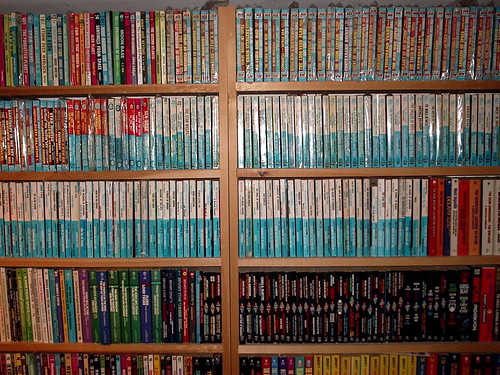
Monday, February 19, 2007
Collecting This is a DELL BOOK
Dell Mapbacks
Between 1942 and 1962 (according to William H. Lyles, Putting Dell on the Map) Dell Publishing Company put out 2,168 paperbacks. Their first (Dell #1) was Philip Ketchum's Death in the Library The back cover sported an eye peeking through a keyhole, and the blurb:
presenting a new exciting Mystery Series selected by the
Editors of America's Foremost Detective Magazines.


The second, third, and fourth books are pictured above, and bore the same back cover content. With Dell #5, Four Frightened Women by George Harmon Coxe, Dell decided to do something new. They included a "Scene of the Murder in 'Four Frightened Women'" on the back cover. It was a hit, and the tradition continued with a total of 577 maps, diagrams, or blueprints adorning their back covers.
(When Ellery Queen's The American Gun Mystery (Dell #4) was reprinted, a map was added to the back cover, replacing the original content).
Dell Mapbacks have fun cover art: sometimes gaudy, sometimes sexy, at times stunningly brilliant. The map on the back covers rarely adds anything but charm. (Notable exceptions are some of the more clever puzzle-mysteries such as Hake Talbot's Rim of the Pit and the mysteries of John Dickson Carr (AKA Carter Dickson). The map from Rim of the Pit pictured here was taken from sketch by the author).


Often the editors abridged the novels that they reprinted. According to Lyles, this abridgement was often pretty merciless.
On the positive side, Dell generally chose top quality mysteries to publish, with authors that included Margaret Millar, Dorothy B. Hughes, Agatha Christie, Brett Halliday, Rex Stout, as well as the aforementioned Queen, Carr, and Coxe. Dell also made it a tradition to include a list of dramatis personae, "The Persons This Mystery is About," before the title page.
The Mapbacks weren't all mysteries. There were some romance novels, adventures, science fiction novels, and some books that, if you judge by the cover, were only meant to titillate. I can't speak for the content of these books, but the covers are pretty fetching.


Below are a few interesting covers - some of them favorites of mine, others just curiosities. Note that the A.A. Fair (Erle Stanley Gardner) novel pictured below, Fools Die on Friday, was later reprinted (as Dell #1542) the woman pictured was showing considerably less skin.


Below are a bunch of the back cover maps. Feel free to click on them for a closer look.


Subscribe to:
Posts (Atom)